Resistance Levels Explained for Program Buyers: How Resistance Is Specified and Tested
A resistance band’s pound rating is only meaningful at a stated test point. It is the force measured when the band is stretched to a defined length — a multiple of its original length, or a percentage elongation. The same band pulls harder the further it is stretched, so “30 lb” with no test point, no dimensions and no material stated cannot be compared with any other supplier’s “30 lb.”
Quick answer: Before comparing two ratings, align four things: dimensions, material and construction, the stretch point, and whether the figure is a single test-point value or a range. If any one is missing, ask for it — the comparison is not valid without it.
What does the test point mean?
A complete specification is a sentence, not a number: force + dimensions + test point.
|
Expression |
Meaning |
Example: 100 cm original length |
|---|---|---|
|
Stretched to 2× its original length |
Pulled to twice its resting length |
200 cm under tension |
|
100% elongation |
Extended by 100% — the same point as 2× |
200 cm under tension |
|
Stretched to 3× its original length (3× elongation) |
Pulled to three times its resting length — the same point as 200% elongation |
300 cm under tension |
Remember one conversion: a multiple and a percentage describe the same point only after you add 1. Stretched to 3× is 200% elongation, not 300%. If a buyer writes “200%” and a factory reads it as “stretched to 200% of original length,” they are testing at different points while using the same words.
But note: the pull force of a resistance tube or band cannot be matched precisely. Elastomer force is not a fixed value — it varies. As an elastomer it has dimensional tolerances; tiny differences in inner/outer diameter and length change the force — before any difference from raw materials and formulation.
How LBP rates its resistance tubes
|
Specification |
LBP resistance tubes |
|---|---|
|
Resistance range |
10–200 lb across the range, from the lightest to the heaviest tube |
|
Test point |
Measured at 3× elongation — stretched to three times its original length |
|
Standard length |
120 cm (4 ft), the same for every resistance level |
|
Tube sizes |
Inner diameter 1.5–8 mm; outer diameter 3–20 mm; wall thickness 1.5–6 mm |
|
Standard set |
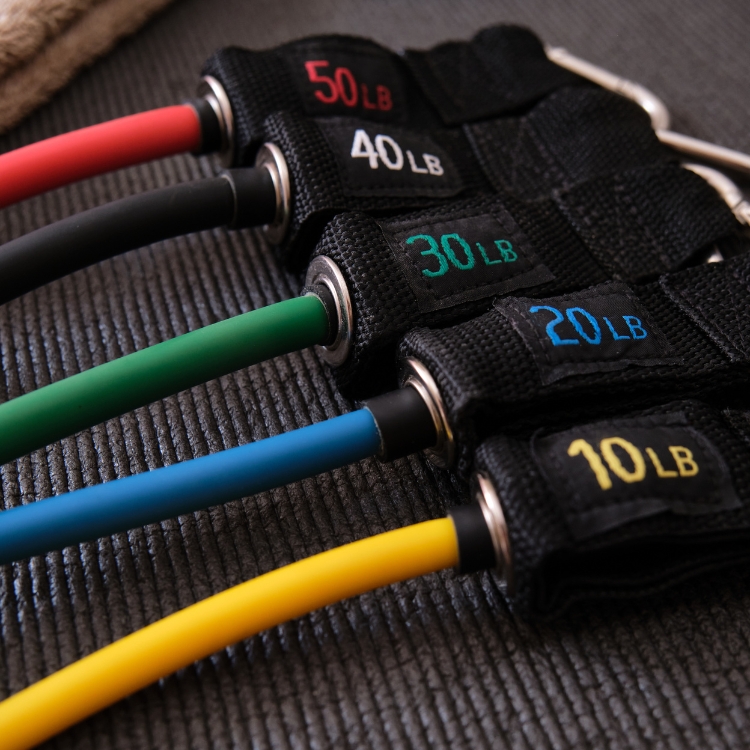
5 tubes in 5 resistance levels, handles, door anchor, ankle straps and carry bag — all changeable to order |
“10–200 lb” is a range across the product line, not one product. Levels differ by tube dimensions, since the standard length is the same for every level. Full specifications are on our resistance tube sets page.
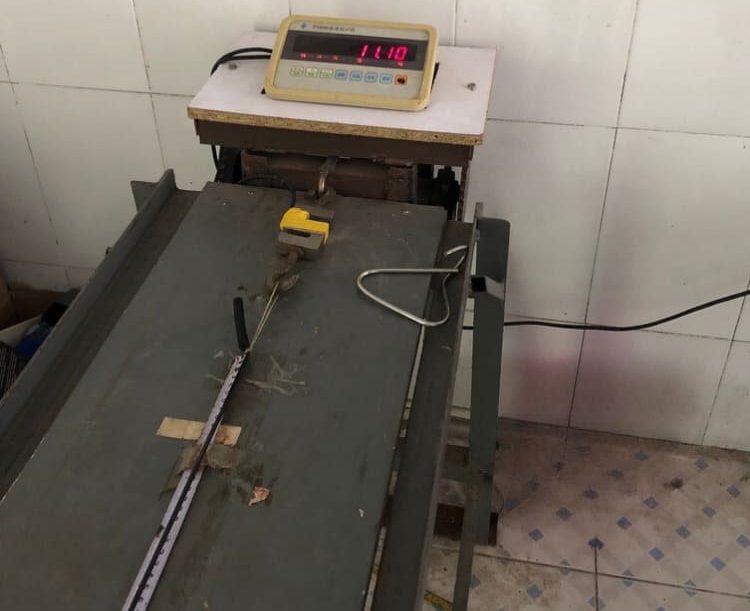
Why does one supplier’s “30 lb” feel different from another’s?
- Test point: the later the point in the stretch, the higher the reading. This alone explains most of the gap between two labels.
- Original length: the same movement is a larger percentage stretch on a shorter band, so a shorter product reaches a given test point sooner.
- Dimensions: width and thickness on bands, or inner/outer diameter and wall thickness on tubes, set how much material is doing the work.
- Material and construction: latex, TPE and fabric have different force–stretch behaviour; they cannot share one force chart.
- Single value vs. range: a range’s top figure and a single test-point figure are not the same kind of number.
Colour cannot settle it either: it identifies a level inside one product line but does not carry the force with it — see our guide to resistance band color codes.
Compare two suppliers’ charts in 30 seconds
- Same test point? Convert both to the same expression. If one supplier cannot state a test point, their figure cannot enter the comparison.
- Same dimensions? Tubes against tubes of the same diameter and length; bands against bands of the same width, thickness and length (see choosing resistance loop sizes).
- Same kind of figure? Single value against single value; range against range, at the same end of the range.
- Then compare forces — and confirm with a sample.
Verify the same way: agree the specification in writing before sampling, approve a physical sample measured at that point, and re-measure production against the same point and the approved sample. Tensile and fatigue testing can be arranged against the customer’s confirmed specification.
Frequently asked questions
What does “measured at 3× elongation” mean?
The force was read when the product was stretched to three times its original length — 200% elongation. Our tube range of 10–200 lb is rated on this basis.
Can I convert one supplier’s rating to another’s?
Not from the printed figures alone. Different test points, dimensions or figure types mean there is no fixed conversion factor. Measure both products at the same test point, or compare physical samples side by side.
What should I ask a supplier before approving a level?
Four things: the force at a stated elongation, the original length the test is based on, the dimensions for that level, and a physical sample you can measure under the same conditions. If any one is missing, the level is still just a label.
The short version
Resistance levels are confusing because the industry prints the answer — the force — and leaves out the question: at what stretch, on what product? Put the test point into your specification, and the samples, the repeat orders and the charts take care of themselves. And remember that a resistance band cannot be made as precise as a dumbbell: most resistance labels are ranges for reference, not exact values. Send us your target levels with the test point you want them measured at, and we will confirm the specification and prepare samples against it.